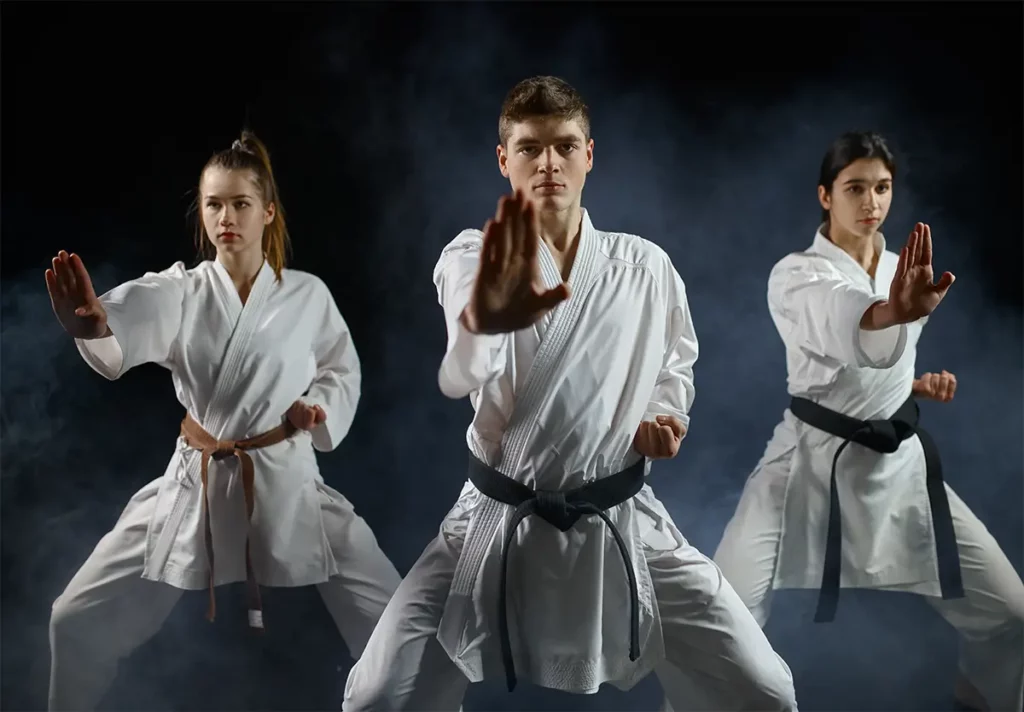
Traditional Japanese Karate is more than just a martial art — it is a lifelong path to self-discovery, personal development, and inner peace. Rooted in centuries of Japanese culture, Traditional Karate integrates the physical discipline of martial training with deep mental and spiritual growth.
It is not simply about learning to punch or kick, nor is it about trophies and competition. The essence of Traditional Karate lies in cultivating a well-balanced mind and body, training to prevent violence rather than provoke it, and nurturing a character of high moral standing.
The Purpose of Traditional Karate
The ultimate goal of Traditional Karate aligns with the central philosophy of Budo — the Japanese way of the warrior. Budo teaches that the highest form of victory is to resolve conflict without resorting to violence. In this light, Traditional Karate becomes a vehicle for character development, inner strength, and harmony. While it includes rigorous training in fighting techniques, its true purpose is far more profound: to build a peaceful spirit, enhance awareness, and cultivate discipline.
Through consistent practice, Traditional Karate enables individuals to build not only physical strength and agility but also mental resilience and emotional balance. It is about facing your inner struggles, overcoming your limitations, and achieving clarity and calmness even in the face of adversity.
Advantages of Traditional Karate
1. Focus on Basic Techniques
Traditional Karate places strong emphasis on mastering the fundamentals — solid stances, precise hand and foot movements, correct posture, and proper breathing. These basics are not seen as entry-level skills to be discarded once advanced techniques are learned. Rather, they are the foundation upon which all other skills are built.
Through repetitive practice of basic techniques, practitioners develop muscle memory, body awareness, and technical precision. This strong base ensures that more advanced applications and self-defense movements are performed with effectiveness and control.
2. Development of Inner Power (Ki / Ch’i)
Unlike many modern sports-based approaches, Traditional Karate explores the concept of ki (or ch’i in Chinese), the internal life energy that flows within every person. Training includes breathing exercises, visualization, and meditation aimed at increasing this internal power and channeling it through physical technique.
The development of ki enhances not only the practitioner’s striking and blocking power but also their mental stability and awareness. It is what gives Traditional Karate its depth and spiritual dimension, transforming it from a system of self-defense into a holistic life practice.
3. Discipline and Patience
Traditional Karate teaches that progress is earned through hard work, time, and patience. There are no shortcuts. Advancement is based not on how quickly a technique is learned, but on how deeply it is understood and embodied. This approach fosters discipline, humility, and perseverance.
Karateka (karate practitioners) are taught to respect their teachers, their dojo (training hall), and their fellow students. This environment nurtures an attitude of respect, self-control, and mental clarity, which carries over into daily life and relationships.
4. Connection with History and Culture
Practicing Traditional Karate is a way of preserving and participating in Japanese culture. Techniques, etiquette, terminology, and philosophy are passed down with great reverence. The dojo kun (training hall rules), bowing rituals, and uniforms all serve as reminders that karate is not just a hobby — it is a way of life rooted in centuries-old traditions.
This cultural connection offers more than just historical appreciation. It instills a sense of identity, purpose, and continuity. Through Karate, one connects with generations of martial artists who have walked the same path in pursuit of wisdom and personal transformation.
5. Mental and Spiritual Development
Perhaps the most powerful aspect of Traditional Karate is its capacity to develop the mind and spirit. Guided by the principles of Bushido — the samurai code of conduct — Karate encourages practitioners to embody values such as courage, integrity, compassion, respect, honesty, and loyalty.
This inner cultivation is what separates Traditional Karate from many modern styles. It is not about dominating an opponent, but about mastering oneself. The real battle in Karate is the battle against ego, fear, laziness, and negativity.
Traditional Karate vs. Modern Karate
While both traditional and modern styles share common roots, there are important distinctions:
- Technique: Traditional Karate emphasizes basic, powerful techniques perfected over time. Modern Karate, especially in sports and competitive formats, often involves more complex or flashier techniques designed for scoring points.
- Training: Traditional Karate favors slow, repetitive, and intensive training to build deep understanding and inner power. Modern Karate may prioritize physical fitness, athletic performance, and competitive readiness.
- Philosophy: Traditional Karate is grounded in the values of Bushido and the spiritual aspects of martial arts. Modern Karate, particularly in sport-oriented forms, often emphasizes winning competitions and achieving external success.
These differences are not about which is “better,” but about different approaches and objectives. Traditional Karate is ideal for those seeking personal growth, discipline, and spiritual development, while modern styles may better suit those interested in sport, speed, or competition.
Conclusion: A Path of Self-Mastery
Choosing Traditional Japanese Karate is choosing a path that honors the past, enriches the present, and prepares one for any future. It is a journey that strengthens the body, sharpens the mind, and awakens the spirit.
In a world that often rewards speed over substance, Traditional Karate offers something timeless — a return to stillness, discipline, and purpose. It invites us to confront our fears, to refine our character, and to discover the quiet strength within ourselves.
While modern karate brings innovation and athletic prowess to the table, the enduring appeal of Traditional Karate lies in its depth, integrity, and spiritual resonance. Whether young or old, beginner or advanced, anyone can benefit from its lessons.
Ultimately, the choice between traditional and modern karate depends on your personal goals. But if you are looking for more than just a way to fight — if you are seeking a way to grow, to transform, and to live with courage and honor — Traditional Japanese Karate may be the perfect path for you.